
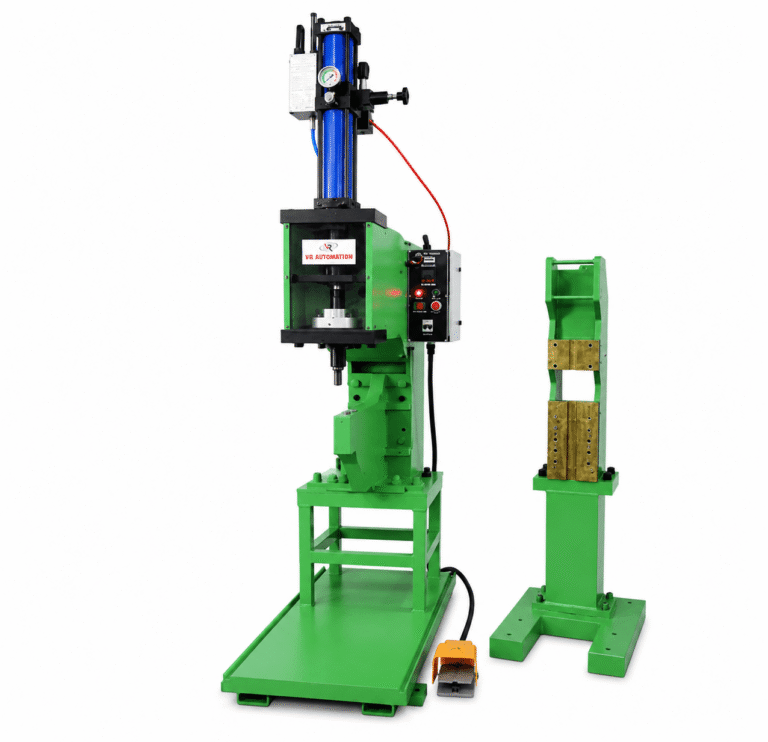
Clinching Press Machine
₹250,000.00
A clinching machine uses a punch and die to plastically deform metal sheets, creating an interlocking, permanent joint without the…
A clinching press machine joins two or more sheets by pressing a punch into them against a die, so the material cold-flows into an interlocking button — no rivet, no fastener and no weld. VR Automation manufactures pneumatic, hydro-pneumatic, C-frame, hand and self-clinching press machines in Bhosari, Pune, for HVAC ducting, enclosures, white goods and automotive sheet metal.
The punch drives the upper sheet into the die cavity, taking the lower sheet with it. As the punch bottoms, material is forced sideways and the die geometry — either a fixed round die with spring segments, or a moving-blade die — lets the lower sheet spread outward beneath the upper one. What forms is a mechanical interlock: an undercut, plus a compressed neck that carries the load. The whole joint is made cold, in one stroke, from the parent material.
Two die families exist. Round-point clinching produces a circular button and is the more common choice; the joint is leak-resistant and looks clean on the punch side. Square-point or rectangular clinching cuts and folds rather than purely draws, which suits thicker or harder stacks and gives higher torsional resistance.
| Criterion | Clinching | Resistance spot welding | Riveting |
|---|---|---|---|
| Consumables | None | Electrode tips, dressing | Rivets, per joint |
| Heat input | None — cold forming | High — localised melting | None |
| Coated / pre-painted steel | Coating survives | Coating burns off; needs rework | Coating survives |
| Dissimilar materials | Steel to aluminium possible | Very difficult | Possible |
| Energy per joint | Low — compressed air | High — large electrical demand | Low |
| Inspection | Visual and dimensional, non-destructive | Usually destructive peel test | Visual |
| Fume and spatter | None | Yes | None |
The practical reading: clinching wins decisively on galvanised, pre-painted and aluminium sheet, and on any line where the cost per joint of rivets or electrode dressing is material. Spot welding still wins where the joint must be flush on both faces or must carry very high peel loads.
HVAC ducting — longitudinal seams and corner joints on galvanised duct, joined without burning the zinc coating. Electrical enclosures and switchgear panels — cabinet bodies, mounting plates and doors in pre-painted or stainless sheet. White goods — washing machine drums and cabinets, refrigerator panels, microwave bodies. Solar — module frames and tracker brackets in aluminium. Automotive — brackets, heat shields, seat structures and increasingly EV battery enclosures, where heat input into the pack is unacceptable. Server racks and cabinets — high-volume sheet metal where a rivet cost per joint would be significant.
Related: hydro-pneumatic presses and pneumatic riveting machines.
₹250,000.00
A clinching machine uses a punch and die to plastically deform metal sheets, creating an interlocking, permanent joint without the…
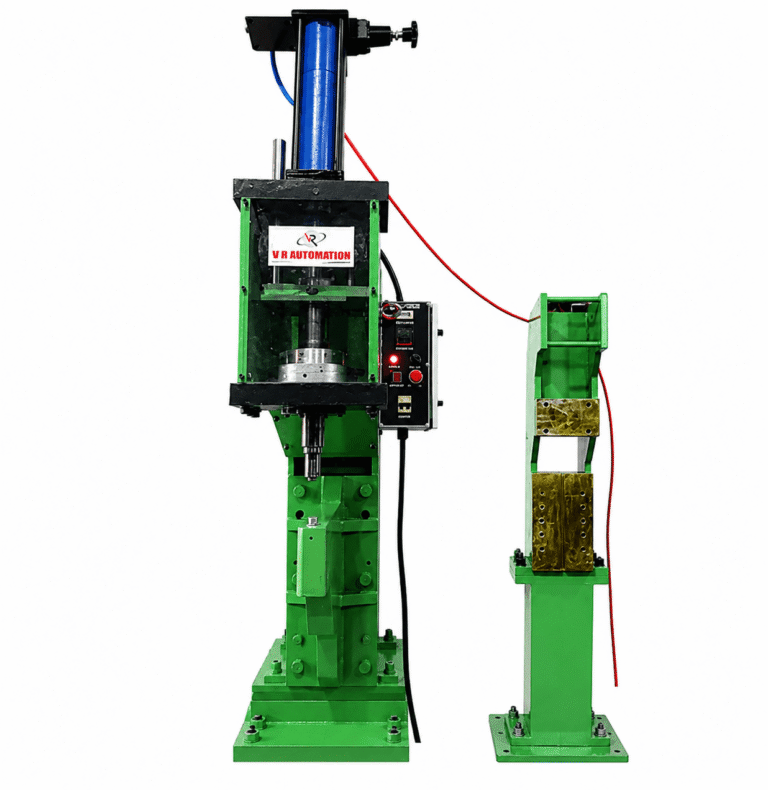
₹175,000.00
C-frame clinching press for production-line rivetless joining. Throat depth and frame built around your component's reach requirement.
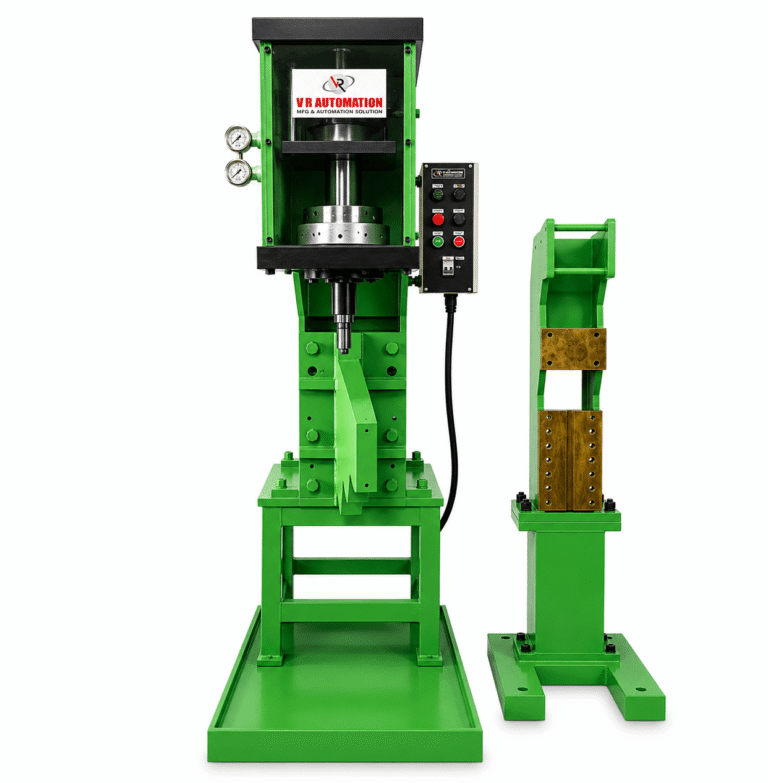
₹170,000.00
Air-operated clinching press that joins sheet metal without rivets, screws or welding. Runs on shop compressed air, needs no consumables…
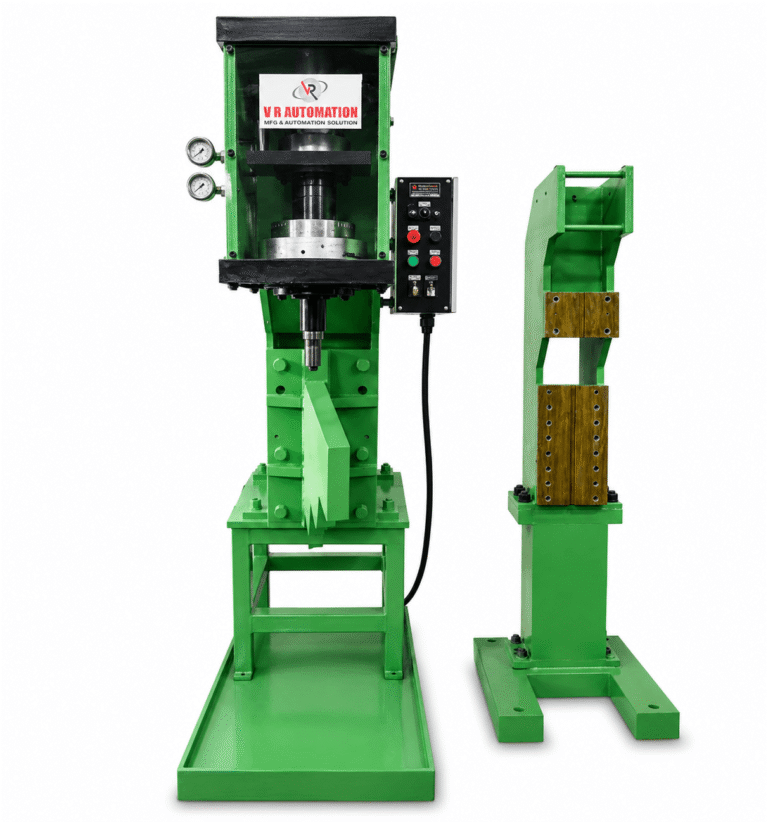
₹215,000.00
Cold-forming clinching machine built for sheet metal fabrication. Joins coated, painted and dissimilar sheet with no heat, no distortion and…
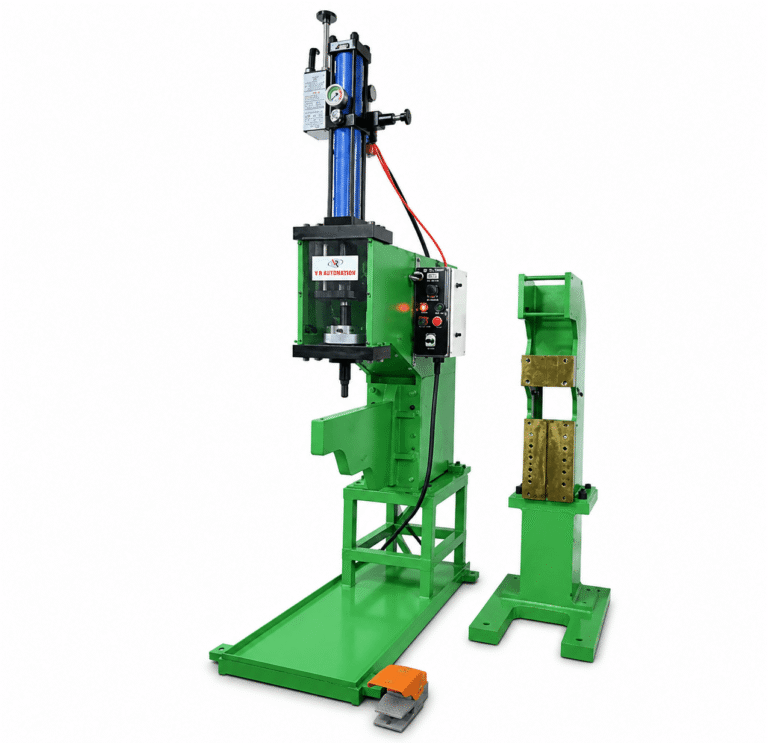
₹180,000.00
Fastener insertion press for self-clinching nuts, studs and standoffs. Seats PEM-style hardware into sheet metal in one controlled stroke.
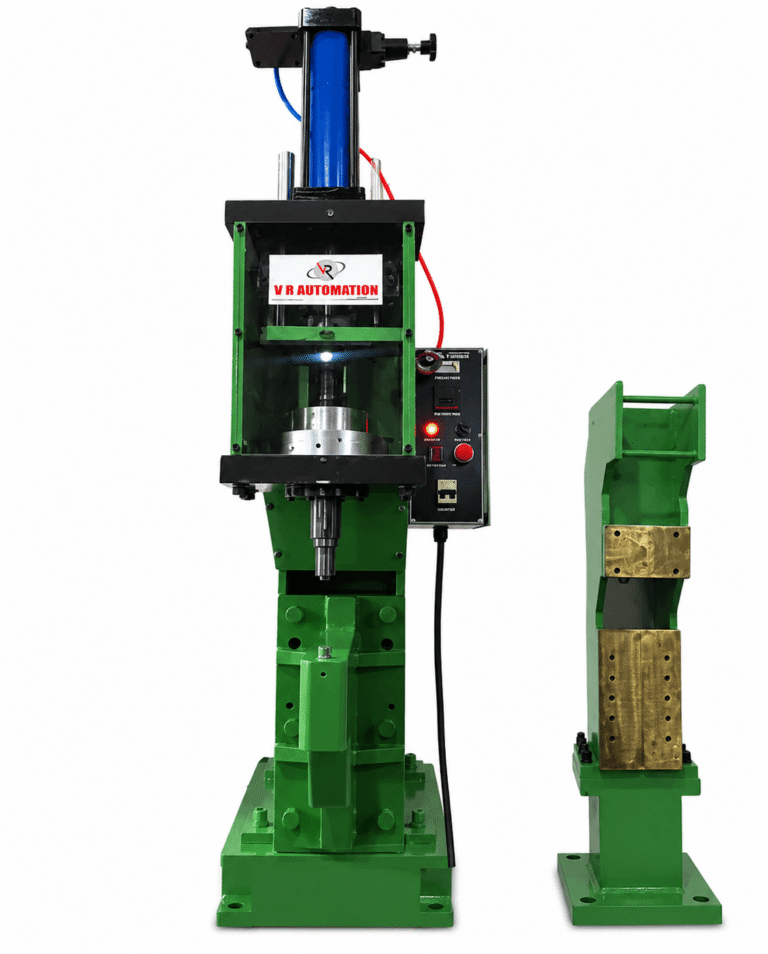
₹155,000.00
Manually operated clinching tool for low-volume, prototype and on-site joining. No air or power supply needed at the point of…
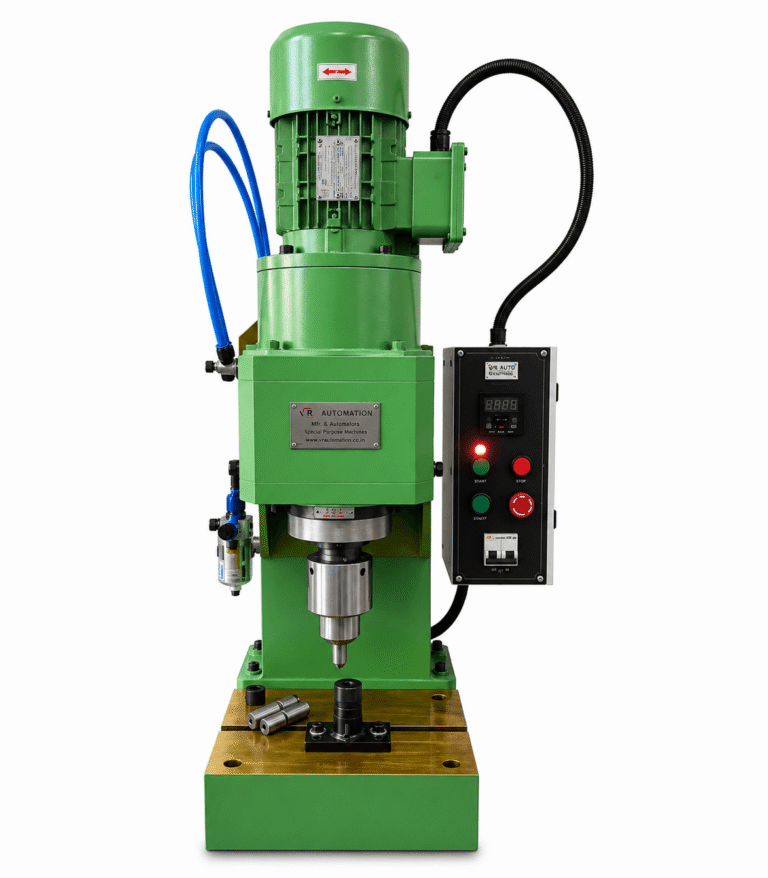
₹120,000.00
Compressed-air rivet press for everyday production riveting, built for long service life with minimal maintenance.
VR Automation clinching machines currently range from about ₹1,55,000 for a hand clinching machine to ₹2,50,000 for a clinching press machine, with self-clinching and sheet metal clinching machines between those figures. Prices are shown live on the product cards above; a firm quotation depends on stack thickness, throat depth and joint count.
A single clinch joint typically carries comparable shear load to a spot weld of similar diameter but lower peel strength. In practice designers compensate by using slightly more joints, and gain a joint that needs no consumables, produces no heat-affected zone, and can be inspected non-destructively. On galvanised and pre-painted sheet the clinch is usually the better joint overall.
Yes. Because clinching is a purely mechanical cold-forming process with no melting, dissimilar metals can be joined — aluminium to steel, and metal to some pre-coated materials — which resistance spot welding cannot do reliably. Ductility of the upper sheet is the limiting factor, not the metallurgy.
Clinching deforms the coating with the base metal rather than burning it off, so corrosion protection is largely retained across the joint. This is the main reason HVAC duct fabricators and enclosure manufacturers move from spot welding to clinching.
Non-destructively. The two governing dimensions are neck thickness (the thinned wall of the button) and undercut (the interlock). Both are checked with a dial gauge or a micrometer-type clinch point inspection tool, and a periodic sectioned sample confirms the setting. No peel test is needed for routine control.
A self-clinching press installs PEM-type hardware — self-clinching nuts, studs and standoffs — into sheet metal. The fastener is pressed into a pre-punched hole, and its knurled shank displaces sheet material into an undercut, creating a permanent threaded feature flush with the panel. It is standard practice in enclosure, server rack and electronics chassis manufacturing.
VR Automation, Bhosari, Pune — riveting, clinching, press and special purpose machines. We quote against your part, not a catalogue.
These products are limited, checkout within
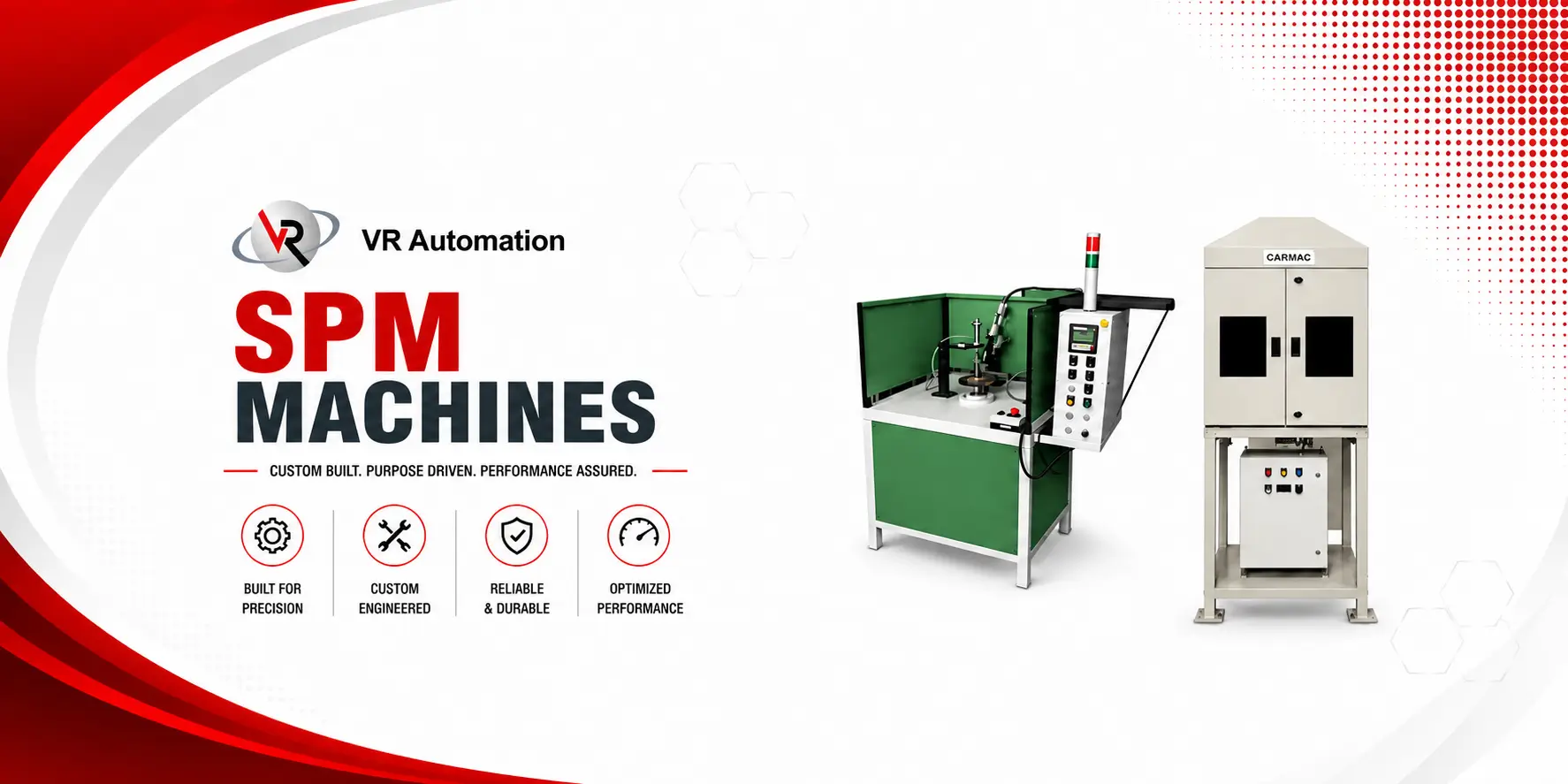
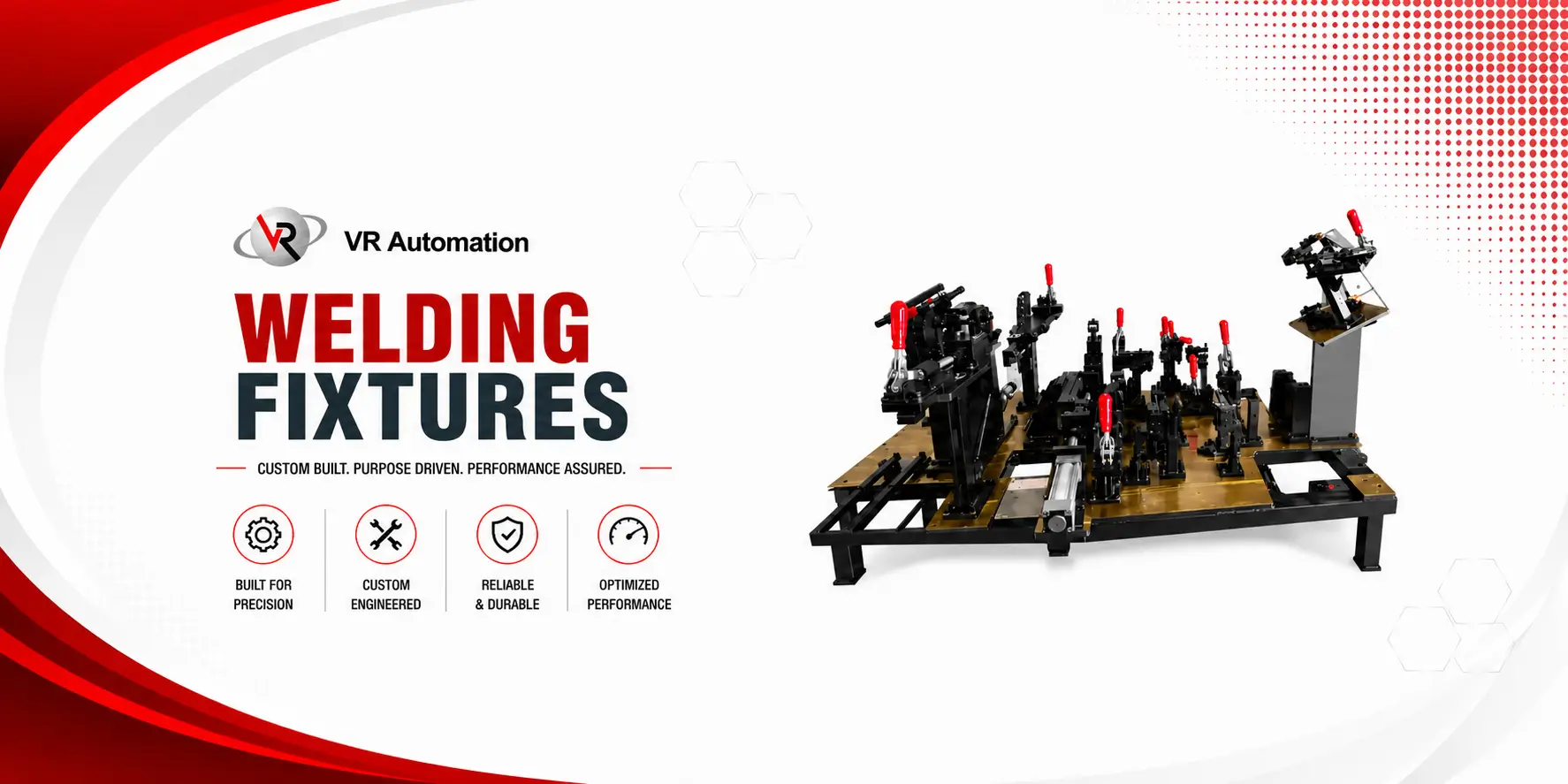
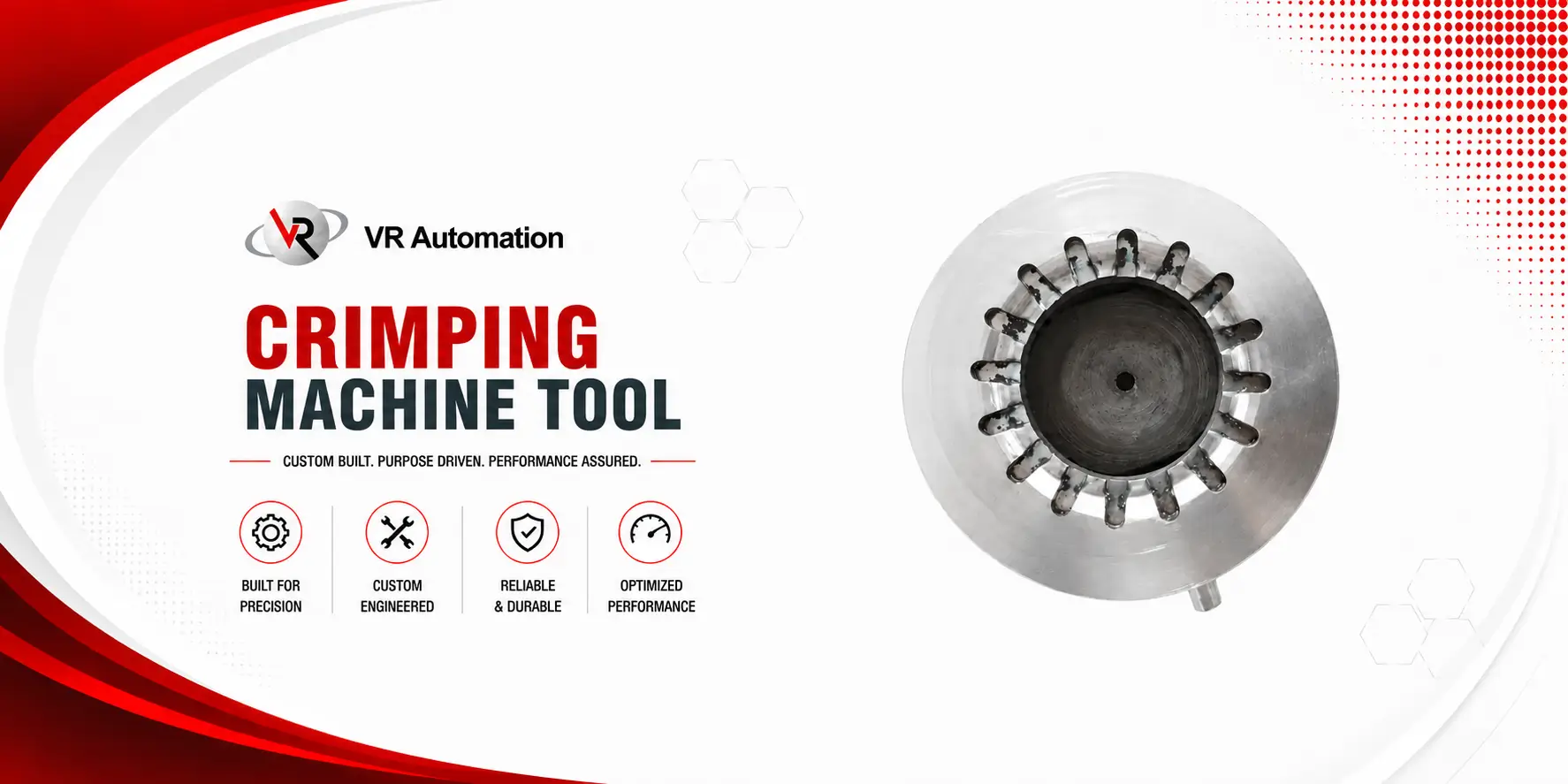
Riveting, clinching, press & SPM machines — built in-house at Bhosari, Pune. Supplied PAN India since 2019.
Tell us about your component and joint. We quote against your part, not a catalogue.